Crochet pattern literacy
How to read a crochet pattern without guessing the terms
First identify the terminology system, then map the construction, stitch placement, turning or joining convention, repeats, gauge, and size. Each instruction should tell you what to make, where the hook goes, and how many countable stitches or spaces remain afterward.
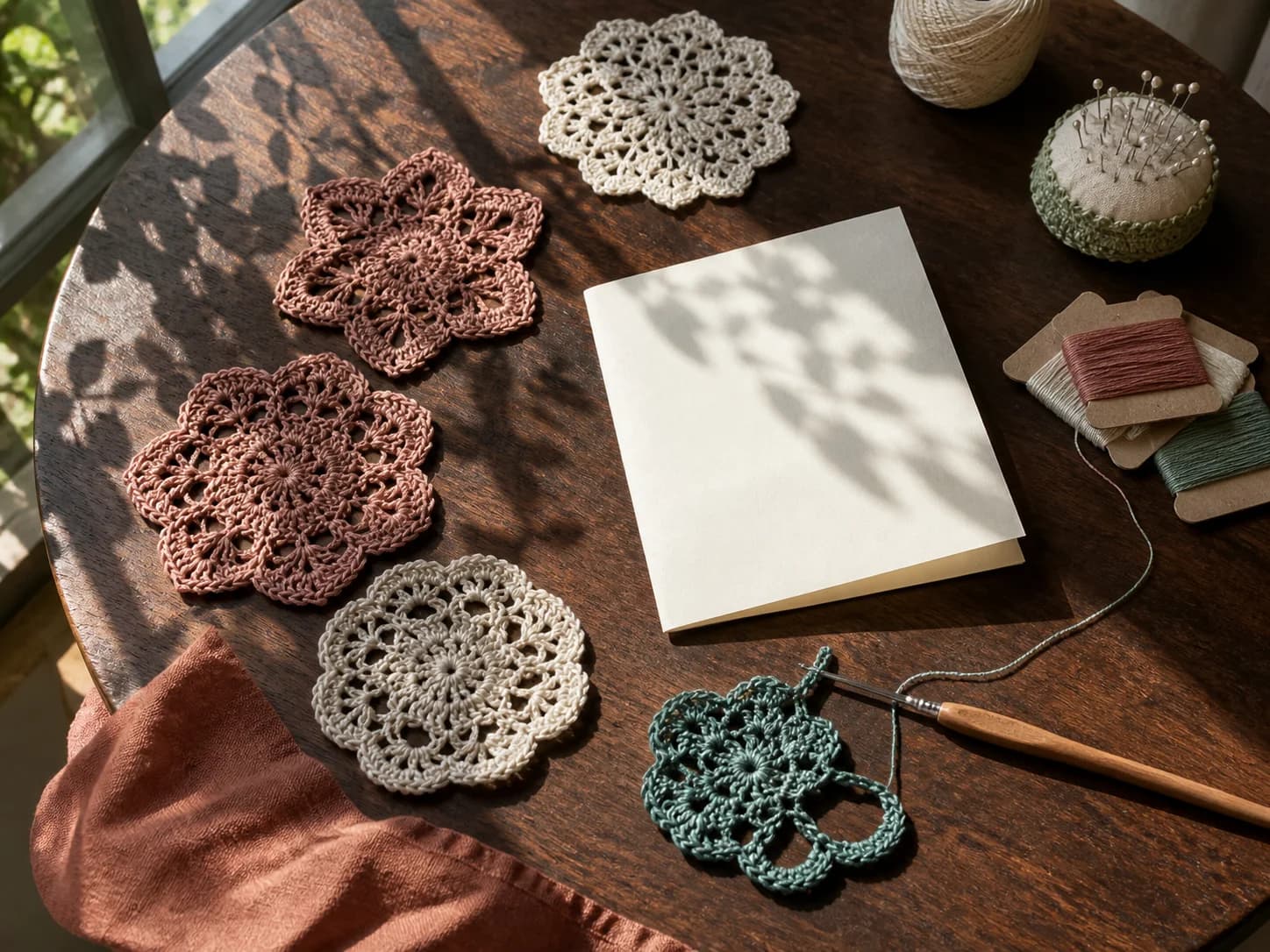
Document anatomy
Find the specifications around the instructions
Read the whole lawful copy once without crocheting. Record the pattern name, designer or publisher, edition or download date, and any official correction notice. Then locate each part below. Their order varies, and a photograph is not a substitute for written construction or measurement information.
If a missing convention changes count, fit, assembly, or safe use, check the publisher's current pattern page and errata. Do not fill a consequential gap from habit simply because another pattern used a similar photograph.
Terminology checkpoint
Match the letters to the stated stitch system
The table below uses common US terminology with a US-to-UK comparison. Use it to recognize ambiguity, then use the individual pattern's key to resolve it.
| US term | Corresponding UK term |
|---|---|
| slip stitch (sl st) | slip stitch (ss) |
| single crochet (sc) | double crochet (dc) |
| half double crochet (hdc) | half treble (htr) |
| double crochet (dc) | treble (tr) |
| treble crochet (tr) | double treble (dtr) |
| double treble (dtr) | triple treble (trtr) |
This is not a spelling difference. If a US pattern says “dc” and you make a UK double crochet, the fabric will be shorter and denser than intended. If a UK pattern says “tr” and you make a US treble, the fabric will be taller. Either error changes gauge, row height, yarn use, and likely finished dimensions.
The presence of “sc” or “hdc” can suggest US usage, while words such as “tension” or “yarn over hook” may appear in other conventions. Clues help you ask the right question; they do not make an unlabelled pattern safe to guess. Confirm the current source, then write US or UK prominently on the working copy.
Action plus location
Translate what to make and where to place it
“Sc in next st” names a stitch action and the next stitch top. “Sc in next ch-1 sp” sends the hook into the opening beneath a previous chain, not into one loop of that chain. Read both the movement and location before inserting the hook.
| Notation | Usual meaning | Question to answer |
|---|---|---|
| ch / ch-sp | Chain / chain space | Does the hook enter a chain loop or the opening beneath it? |
| st / sp | Stitch / space | Which physical opening is next? |
| sk | Skip | What replaces the skipped position in the new count? |
| FLO / BLO | Front loop only / back loop only | Which loop of the stitch top is used from your working view? |
| inc / dec | Increase / decrease | How many inputs and outputs does this pattern's method have? |
| RS / WS | Right side / wrong side | Which face should be toward you? |
| rnd / rep | Round / repeat | Where does the unit begin and end? |
Parentheses can show a final count, contain size alternatives, or group several stitches worked in one location. Brackets can group a repeat, while asterisks can mark its boundary. Label each mark in the current line—count, size, same location, or repeat—rather than assigning one universal meaning.
Size selection
Keep one position through every list of numbers
Suppose sizes are XS (S, M, L) and foundation counts are 72 (80, 88, 96). Medium occupies the third position, so its count is 88. Maintain that position in every later list, including yarn quantity, repeat count, length, shaping, and finishing. Highlight the chosen column and copy only its figures to a run sheet without changing the original.
Letter sizes are not universal measurements. Compare the stated body measurement with the finished measurement and intended ease. Examine garment length, armhole depth, sleeve width, and motif layout as well as circumference. A motif or textured repeat may allow changes only in whole units, so adding an arbitrary number of chains can break both the repeat and the edge treatment.
Gauge or tension
Match the named fabric and finished condition
“16 stitches and 18 rows = 4 in / 10 cm in US single crochet after blocking” supplies a terminology system, stitch, two rates, span, and finished state. A motif gauge may instead give the width and height of one complete motif. Test the unit the designer actually names using project yarn and the same flat or circular construction.
Sixteen stitches over four inches equals four stitches per inch, so 24 stitches predict six inches before borders or seams. If your finished swatch has 18 stitches over four inches, the same count predicts about 5.33 inches. That difference accumulates around a fitted object.
Use the listed hook as a starting point. Change the hook or another controllable factor, make a new sample, wash it as the project will be washed, and judge drape and density along with the number. Use the full gauge-swatch process.
Repeat grammar
Count what one repeat consumes and produces
In “*ch 1, sk next st, sc in next st; rep from *,” one repeat consumes two positions from the preceding row. One is skipped and one receives a single crochet. The new unit contains one chain space and one single crochet, subject to the pattern's rule about whether that chain counts as a stitch.
Edge instructions can sit outside the repeat: “sc in first st, *ch 1, sk next st, sc in next st; rep from * to last st, sc in last st.” Do not return to the beginning of the line, because that would duplicate the first edge stitch. Draw separate boxes for the first stitch, one repeat, and the last stitch before doing the arithmetic.
“Repeat Rows 2 and 3 three more times” means the pair was completed once and must be worked three additional times. Those cycles become Rows 4–5, 6–7, and 8–9. Writing the resulting numbers prevents one extra pair from appearing.
Construction direction
Do not interchange rows, joined rounds, and spirals
Rows and the turning chain
Rows travel across a flat edge and normally turn. The turning chain raises the active loop, but the pattern decides whether it counts as the first stitch. If it does not count, the first actual stitch may go into the first stitch below it. If it does count, using that point again can add a stitch. Mark the first and last countable stitches until the edge convention is unmistakable.
Joined rounds
A joined round closes with an explicit join, often a slip stitch. The next round begins with the stated chain or standing stitch. Determine whether the join and beginning chain count; neither belongs in the stitch total unless the pattern says it does. Also note whether each joined round turns or keeps the same face outward.
Continuous rounds
A spiral does not close each round with a join. Mark the first stitch and move the marker into the new first stitch every time. Round numbers remain important because shaping and color changes use them as checkpoints. Do not add a join merely because another project did.
Symbol charts
Read the starting mark, direction, and key together
Locate the starting arrow or symbol, row or round numbers, directional arrows, repeat boundary, color key, and special-stitch legend. A symbol aligned above a chain space has a different placement from one aligned above a stitch top.
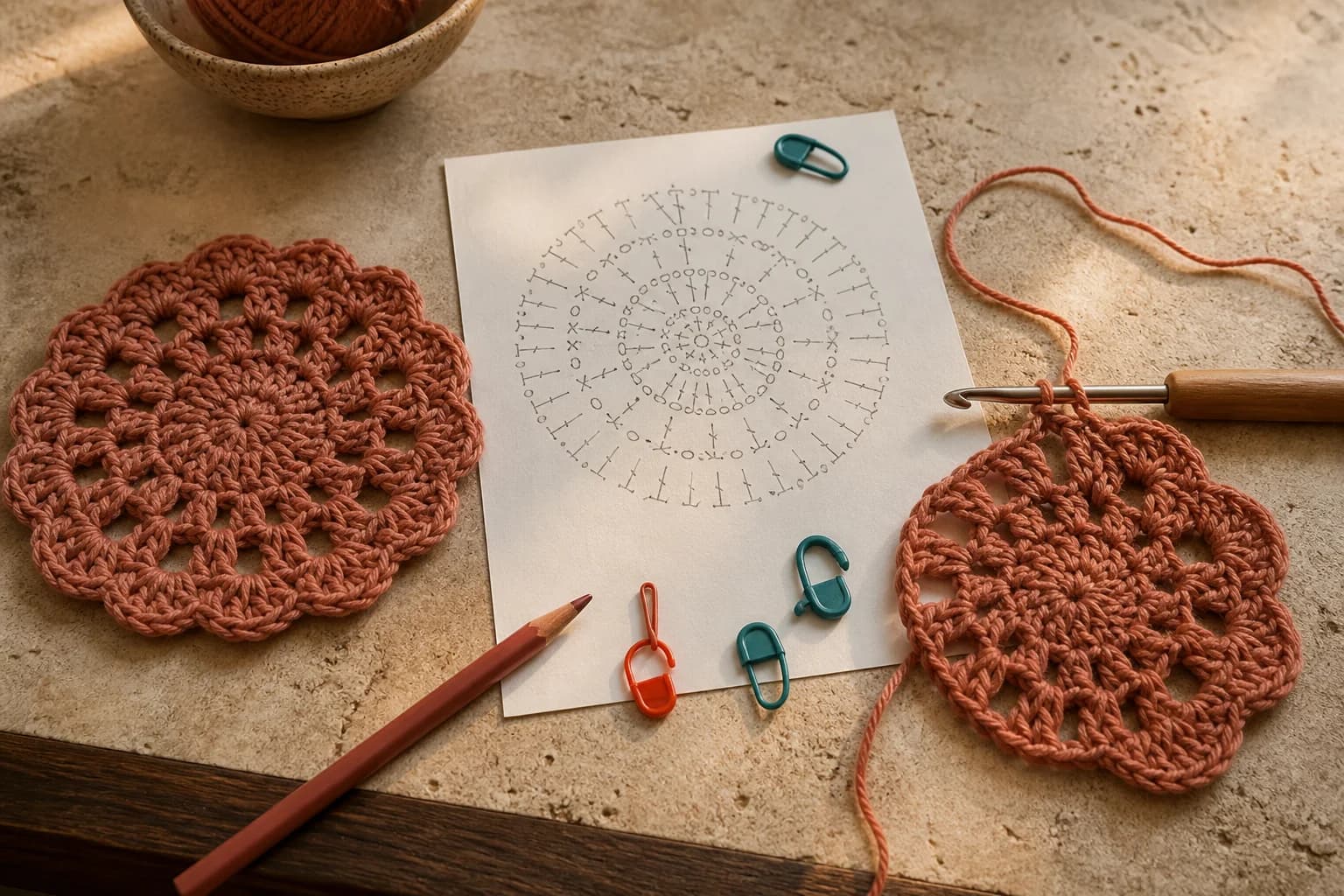
Flat charts often change direction with each row, while round charts travel around a center, but the supplied arrows and notes decide the direction.
Common chart symbols can vary by designer, so use the individual pattern key. Compare the chart with written counts after every repeat or shaping round rather than treating the picture as decoration.
Worked reading exercise
Decode a fictional US crochet mesh panel
Short fictional excerpt for interpretation practice.
Terminology: US crochet terms.
Sizes: S (M, L).
Gauge: 16 sc and 18 rows = 4 in / 10 cm in blocked US single crochet.
Notes: Ch 1 does not count as a stitch. Turn after every row.
Foundation: Ch 21 (25, 29).
Row 1 (RS): Sc in 2nd ch from hook and in each ch across—20 (24, 28) sc.
Row 2: Ch 1, turn; sc in first sc, *ch 1, sk next sc, sc in next sc; rep from * to last sc, sc in last sc—20 (24, 28) sts.
Row 3: Ch 1, turn; sc in first sc, *sc in next ch-1 sp, sc in next sc; rep from * to last sc, sc in last sc—20 (24, 28) sc.
Rep Rows 2 and 3 three more times. Fasten off after Row 9.
Choose medium and trace Row 1
Medium is the second value: chain 25 and finish with 24 US single crochets. The active loop is not a chain. Skipping the first completed chain supplies turning height, leaving 24 foundation chains to receive stitches.
Check the Row 2 count
The first single crochet is outside the repeat. For medium, 11 repeats each create a chain space and a single crochet; the last single crochet is also outside. The count is 1 + 22 + 1 = 24 positions. The chain spaces count here because Row 3 must work into them, not because every pattern counts every chain the same way.
Restore solid stitches on Row 3
Each “ch-1 sp” is the opening beneath the chain. Working one single crochet into every space and the next single crochet restores 24 solid single crochets. Repeating Rows 2 and 3 three more times creates Rows 4–9, so the final line is a solid Row-3-type pass before fastening off.
Identify the missing specifications
The gauge is measured in solid single crochet while alternate rows use mesh. A real pattern would need finished dimensions or additional construction information showing how that gauge controls size. The excerpt also omits yarn quantity, use, and finishing, which is why it remains a reading exercise rather than a pattern.
Contrast one fictional joined round
Rnd 1: Ch 24, join with sl st in first ch without twisting; ch 1 (does not count), sc in same ch and each ch around; join with sl st to first sc—24 sc.
The first slip stitch closes the foundation ring. The chain 1 raises the loop but is excluded from the count. Twenty-four single crochets form the round, and the final slip stitch closes it without becoming a twenty-fifth stitch. Marking the first single crochet separates it from the nearby chain and join.
During the project
Record the state after every completed line
Keep the original pattern intact and make a lawful personal run sheet. For each row or round, record its number, right- or wrong-side orientation, whether you turn or join, whether the starting chain counts, marker location, repeat count, active size, and final number of stitches or spaces.
- Write US or UK at the top of every working page.
- Use different marker colors for the first stitch, shaping, and repeats.
- Circle groups worked into one location.
- Box chain spaces needed on the following row.
- Write size-specific counts before shaping.
- Check official errata when the arithmetic fails.
If the count changes unexpectedly, secure the active loop and return to the last confirmed line. Inspect the first stitch, repeat unit, last stitch, turning chain, and join. A widening edge often includes an extra edge insertion; a narrowing edge often omits the final stitch.
Return to the learning hub, practise stitch anatomy in the beginner crochet path, or consult the yarn decision guide before substituting materials.