Length before skeins
Calculate how much yarn a project needs
Enter the pattern’s total metres or yards for your exact size and the length in one chosen package. The calculator converts mixed units, adds only the extras you name, and rounds the final shopping quantity up to whole packages.
Working calculator
Turn length into whole packages
Use the total for one color. Metres and yards may differ; the calculator converts them before dividing.
Shopping quantity
Buy 7 skeins
1,250 m ÷ 200 m ≈ 6.25; round up to 7.
- Required
- 1,250 m
- Named extra
- 0 m
- Reserve
- 0 m (0%)
- Length supplied
- 1,400 m
- Above this plan
- 150 m
Calculate from your swatch
Use the dry swatch mass and dimensions of the same measured fabric. A gauge handoff carries counted-area dimensions; change them here if you weighed the whole, larger swatch. Keep stitch pattern and fabric density unchanged. Borders and fringe are separate quantities.
Example result for the measurements below.
6 packages for this blanket
- Swatch-scaled centre size
- 100 × 120 cm
- Centre area / swatch area
- 30 ×
- Estimated centre fabric mass
- 600 g
- Centre yarn before extras
- 1,200 m / 1,312.34 yd
- Border yarn entered
- 0 m
- Other extra length entered
- 0 m
- Reserve
- 0%
- Length including extras and reserve
- 1,200 m / 1,312.34 yd
- Surplus after whole-package rounding
- 0 m / 0 yd
The centre estimate scales your measured fabric. A different border stitch needs its own yarn allowance; do not count border fabric twice. Include the swatch yarn in other extras if it is not reused.
Blanket yarn worksheet
Record the finished size, measured swatch, border allowance and package label alongside the result.
- Swatch width
- 20
- Swatch height
- 20
- Swatch dimension unit
- cm
- Dry swatch mass (g)
- 20
- Finished blanket width
- 100
- Finished blanket length
- 120
- Project dimension unit
- cm
- Uniform border width (same unit)
- 0
- One package mass (g)
- 100
- One package length
- 200
- Yarn length unit
- m
- Measured or planned border yarn length
- 0
- Other extra length (same yarn unit)
- 0
- Reserve (%)
- 0
Write before dividing
Collect five inputs in one unit
Quantity errors often begin before the arithmetic. The selected size may be wrong, the yarn package may be a different put-up from the one quoted online, or two colors may have been combined into one total. Photograph the physical band and copy each value with its unit.
| Input | What to record |
|---|---|
| Pattern requirement | Total length for the exact size or version, with each color kept separate |
| Candidate package | Length per complete ball, skein, cone, cake, or hank—not package mass alone |
| Already used | Length consumed by swatches, samples, or an earlier section if it came from the same supply |
| Planned changes | Added length, width, motifs, sleeves, fringe, borders, or another documented modification |
| Inventory evidence | Number of full packages plus estimated partial-package length, color, and dye lot |
Use the yarn-label guide if package mass, strand-weight category, and package length are easy to confuse. Grams or ounces alone cannot answer how many packages to buy because different yarns supply different lengths for the same mass.
The direct case
Calculate balls or skeins from a stated total length
- Find the pattern’s required total for the exact size, length, or version you will make.
- Confirm whether the pattern total is metres or yards and whether it includes all colors.
- Copy the length on one physical package of the yarn you will use.
- Convert one value if the units differ, then divide required length by package length.
- Add any documented modification length and round the final package result upward.
Worked example: one-color project
A pattern requires 1,250 m for the selected size. The candidate yarn supplies 200 m per skein.
1,250 m ÷ 200 m per skein = 6.25 skeins
The mathematical requirement is 6.25, so the shopping quantity is seven skeins. Do not round to six because 6 × 200 m supplies only 1,200 m, which is 50 m short before accounting for a swatch.
This answer applies only to the pattern version and candidate package in the example. Another size, yarn put-up, gauge, or modification changes an input and therefore changes the result.
When total length is omitted
Convert an original yarn’s ball count before substituting
An old or concise pattern may say “six balls” of a named yarn. Find evidence for the original length per ball and multiply. Then divide that total by the candidate length. Do not carry the number six across to a differently sized package.
Worked example: changing put-up
The pattern names six original balls, each documented as 180 m. That represents 6 × 180 m = 1,080 m. A candidate supplies 250 m per skein, so 1,080 ÷ 250 = 4.32. The mathematical minimum is five candidate skeins.
This conversion preserves the original published supply; it does not prove the candidate is a suitable yarn. Complete the substitution workflow and approve the washed fabric before buying the converted quantity. If the original package length cannot be established, label the result as an estimate rather than inventing a precise total.
One calculation, one unit
Keep metres and yards consistent
Never divide a metre requirement by yards per ball or the reverse. Convert the pattern total and package length to the same unit, write the converted value beside the original, and complete the rest of the worksheet in that unit. Preserve enough decimal places during conversion and round only the final package count.
The internationally defined relationship is 1 yard = 0.9144 metre exactly. Therefore:
yards × 0.9144 = metresmetres ÷ 0.9144 = yards
Worked example: pattern in yards, label in metres
A pattern requires 1,100 yd. Convert that total: 1,100 × 0.9144 = 1,005.84 m. If each ball supplies 150 m, then 1,005.84 ÷ 150 = 6.7056. Round up to seven balls.
The conversion does not add an allowance. It only expresses the same length in another unit. Add a justified project change as a separate line so that the source of the extra yarn remains visible.
Inventory, not appearance
Estimate the length left in a partial ball
If a partial ball is from the exact labelled yarn, estimate its length from its remaining mass. Use a scale with suitable resolution, remove the band or subtract its mass consistently, and keep the same mass unit throughout.
Worked example: a weighed remainder
A full ball is labelled 100 g / 240 m. The unbanded remainder weighs 63 g. The estimate is 63 × 240 ÷ 100 = 151.2 m. Record it as approximately 151 m rather than exactly 151.2 m, because labels, home scales, moisture, and handling make this an estimate.
This method assumes the remainder is the labelled yarn and has not been combined with another product. It cannot identify an unknown yarn, recover a missing dye lot, or account for unusable knots and damaged sections. If the remaining length is close to the project’s requirement, choose a larger safety margin or a design that can stop gracefully.
For several partial balls of the same yarn and color, weigh and record each one or their clean combined mass. Keep different colors and dye lots separate so a sufficient grand total does not conceal a shortage in the part that must match.
No published pattern total
Estimate a simple custom project from a measured swatch
A swatch can estimate yarn for a uniform rectangle such as a plain scarf or simple blanket. Choose a finished blanket size before entering the measured width and length. It is less dependable for fitted garments, shaped pieces, cables, mixed stitches, sleeves, necklines, motifs, or borders because those features do not scale as one uninterrupted area.
- Make and finish a representative swatch in the exact yarn, stitch, gauge, and care process.
- Measure a central area and weigh the yarn used for that area. Do not include unrelated borders or tails in one value and omit them in the other.
- Calculate the simple project’s fabric area and divide it by the measured swatch area.
- Multiply the swatch yarn mass or length by that area ratio, then add separately estimated borders, seams, fringe, swatching, and other features.
Worked example: a uniform rectangle
A finished 20 cm × 20 cm swatch area uses 14 g. Its area is 400 cm². A planned 100 cm × 120 cm rectangle has 12,000 cm², so it contains 30 of those swatch areas. The central fabric estimate is 30 × 14 g = 420 g.
If the yarn is labelled 100 g / 200 m, the corresponding central estimate is 420 × 200 ÷ 100 = 840 m. Border, starting and finishing tails, swatch yarn, joins, and design changes are not inside that number. Add them as named worksheet lines. A second larger sample can help reveal whether the first was representative before a major purchase.
Use this measured-swatch method for a flat, uniform rectangle. Work the sample in the same yarn, stitch, gauge, and finished state as the planned fabric. Calculate borders, fringe, shaped areas, and different stitch patterns as separate components using their own representative samples or pattern totals.
Explain every extra
Plan swatching, modifications, and uncertainty
Use a pattern-stated allowance when available. If you create your own, do not present one percentage as correct for all projects. Instead, name what may consume more yarn and estimate it from the closest evidence.
Returnability, availability, and dye lot influence the practical choice. Buying one additional package can be sensible when a later match is unlikely, but that is a project decision—not a mathematical law. Check the seller’s return conditions before relying on unused yarn being returnable.
One worksheet per color
Calculate stripes, colorwork, and borders separately
When a pattern gives per-color quantities, run the package formula for each color and round each result up. Rounding only the grand total can leave the main color short while surplus contrast yarn makes the total look sufficient.
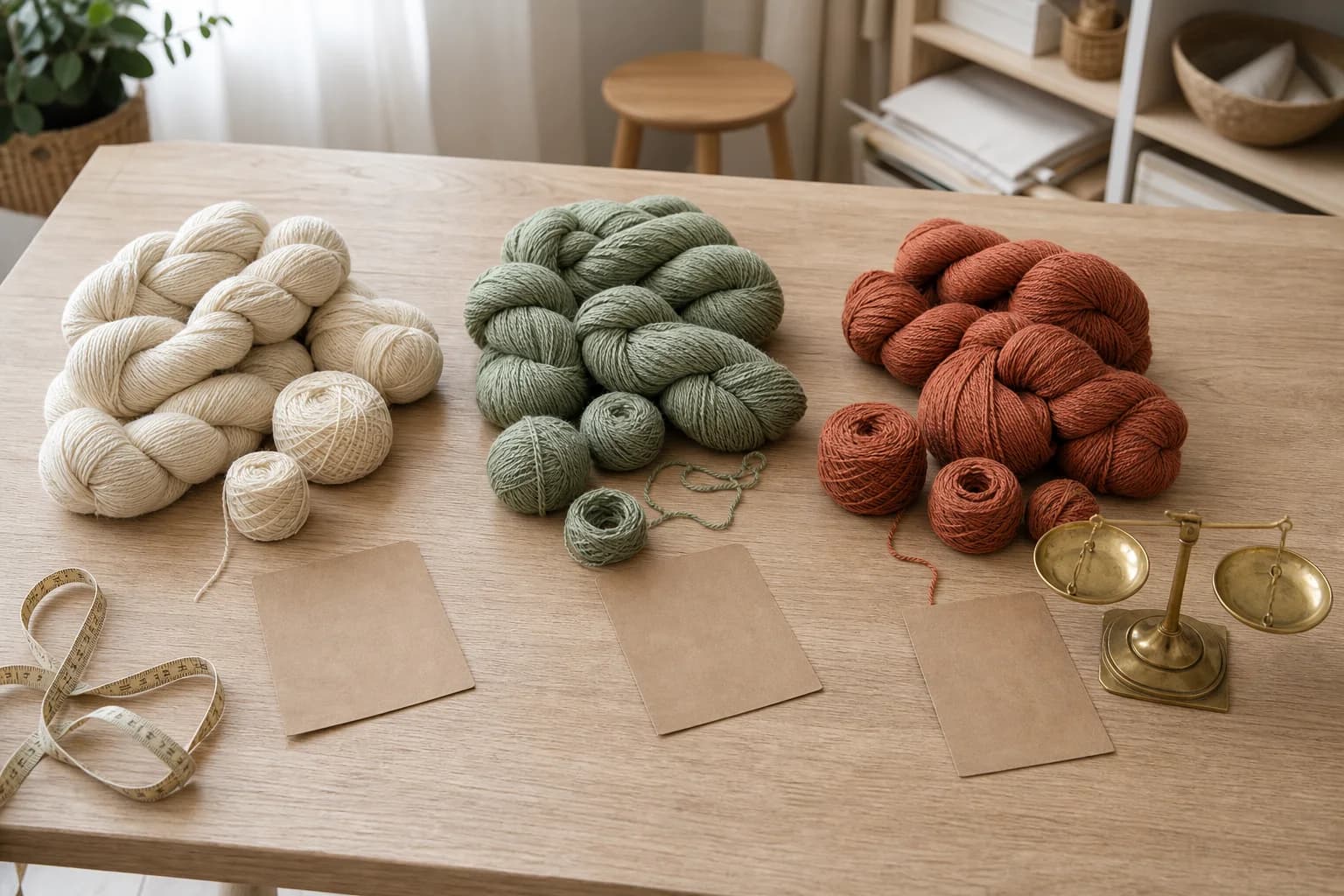
Worked example: three allocations
A project requires 720 m of the main color, 135 m of contrast A, and 90 m of contrast B. All three are sold in 200 m skeins.
- Main:
720 ÷ 200 = 3.6, so buy four skeins. - Contrast A:
135 ÷ 200 = 0.675, so buy one skein. - Contrast B:
90 ÷ 200 = 0.45, so buy one skein.
The project requires six packages even though (720 + 135 + 90) ÷ 200 = 4.725 rounds to five. The pooled answer fails because a package of one color cannot supply another.
If you reverse colors or change stripe widths, create new allocations. A quick sketch can help decide the arrangement, but the quantity still comes from the number and size of repeats or from a measured representative sample.
Audit the worksheet
Check the result before buying
| Mistake | Correction |
|---|---|
| Copying the original ball count | Balls and skeins are package shapes, not standard quantities. Convert the original supply to total length first. |
| Dividing metres by yards | Both numbers describe length, but they are not interchangeable. Convert one side, label the converted value, then calculate. |
| Rounding down | A shop cannot sell the missing fraction of a normal ball. Round the final result up to the next complete package. |
| Pooling all colors | Enough total yarn does not prove that the project has enough of the main, contrast, or border color. |
| Treating a partial ball as full | Weigh the remainder and estimate its length from the same label rather than counting its outer size or shape. |
- Reconfirm the pattern size and finished measurements.
- Reconfirm total length for every color in one consistent unit.
- Read length from the candidate package you will actually receive.
- Verify the multiplication, division, and upward rounding.
- List swatch yarn and every modification or finishing component.
- Confirm color and dye lot across the packages when applicable.
- Save the labels and the dated worksheet with the project.
Quantity arithmetic answers how much of the chosen yarn to obtain. It does not establish whether that yarn will reach the needed gauge or make a useful fabric. Review the gauge-swatch method and substitution decision before committing to a full purchase.