Yarn thickness
Yarn weight chart: categories 0 to 7
A yarn-weight number is a broad thickness category: 0 is the finest and 7 is the thickest. Use it to narrow your choices, then use the pattern gauge and a washed swatch to decide whether one particular yarn works.
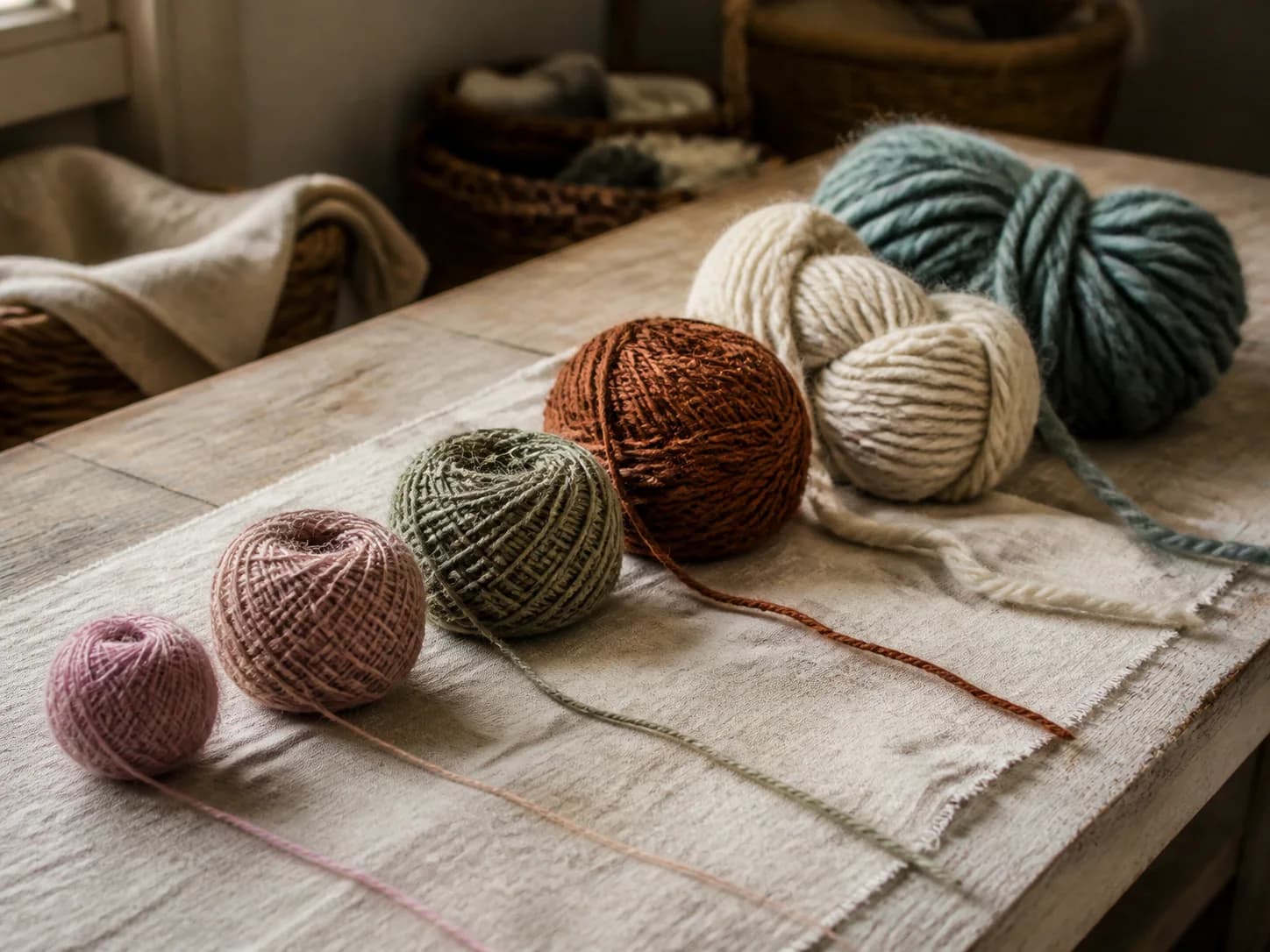
Find a yarn-weight category
Choose the number on your label. The range is a starting point for a swatch, not a fixed recipe.
4: Medium / worsted
Also called: Worsted, aran, afghan. Reference stockinette gauge: 16–20 stitches over 4 in / 10 cm.
Starting tools: 4.5–5.5 mm needles; 5.5–6.5 mm hooks.
Find DK, worsted, fingering and chunky yarn
Names vary between makers and regions. DK is commonly light (3), worsted and aran medium (4), and chunky bulky (5). Ply naming is not a count-to-category formula. Check the numbered category and washed gauge together.
| Category and profile | Names on labels | Needles (mm) | Hooks (mm) |
|---|---|---|---|
| 0: Lace | Fine lace yarn, crochet thread | 1.5–2.25 | 1.4–1.6 steel; 2.25 regular |
| 1: Super fine / fingering | Sock, fingering, baby | 2.25–3.25 | 2.25–3.5 |
| 2: Fine / sport | Sport, baby | 3.25–3.75 | 3.5–4.5 |
| 3: Light / DK | DK, double knitting, light worsted | 3.75–4.5 | 4.5–5.5 |
| 4: Medium / worsted | Worsted, aran, afghan | 4.5–5.5 | 5.5–6.5 |
| 5: Bulky / chunky | Chunky, craft, rug | 5.5–8 | 6.5–9 |
| 6: Super bulky | Super chunky, roving-style yarn | 8–12.75 | 9–15 |
| 7: Jumbo | Jumbo, very thick roving-style yarn | 12.75 or larger | 15 or larger |
Convert common needle and hook size labels. Larger tools can be intentional in lace; the pattern’s finished gauge controls.
Read carefully
Do not confuse these four label numbers
“Weight” is used in two different ways on a yarn band. The category describes strand thickness, while net weight describes the mass of yarn in the package. Length and gauge answer two more separate questions. Keeping the four apart prevents most buying errors.
For example, a 100 g ball is not automatically thicker than a 50 g ball. It may simply contain more of a fine yarn. Likewise, two 100 g balls can contain very different lengths because their strands and fibers differ. Record the category, net weight, and length as three separate facts.
Reference table
The standard yarn-weight categories
The following numbered categories and reference ranges are widely used. The knit gauge shown is for stockinette over 4 in / 10 cm. The needle range is a starting point, not a requirement. Lace is frequently worked outside its range to create open fabric.
| Category | Standard name | Reference knit gauge | Reference needle range |
|---|---|---|---|
| 0 | Lace | 33–40 stitches | 1.5–2.25 mm |
| 1 | Super fine | 27–32 stitches | 2.25–3.25 mm |
| 2 | Fine | 23–26 stitches | 3.25–3.75 mm |
| 3 | Light | 21–24 stitches | 3.75–4.5 mm |
| 4 | Medium | 16–20 stitches | 4.5–5.5 mm |
| 5 | Bulky | 12–15 stitches | 5.5–8 mm |
| 6 | Super bulky | 7–11 stitches | 8–12.75 mm |
| 7 | Jumbo | 6 stitches or fewer | 12.75 mm or larger |
Follow the pattern's stated gauge when it differs from the broad category guidance.
A broad filter
What a weight category cannot tell you
A category does not promise a particular fiber, yardage, finished measurement, warmth, drape, elasticity, opacity, or care method. It also does not guarantee that every yarn in the category produces the same stitch count on the same tool. The ranges overlap because yarn and fabric are more varied than one label number can express.
Construction changes what your hands and eyes perceive. A smooth, tightly constructed strand can look slimmer than a lofty or brushed strand even when both sit in the same category. A chainette, single, cable, ribbon, or fuzzy yarn may fill space differently. Color and stitch pattern can change how clearly individual stitches appear.
Regional and traditional names can also overlap. “Worsted,” “aran,” “DK,” “sport,” and “fingering” are useful clues, but the number on a current label is clearer when it is available. Do not convert a ply name or product name to a numbered category without supporting label information or a physical check.
Pattern-first workflow
Choose a yarn weight for an existing pattern
- Find the pattern's requested yarn, category, gauge, stitch used for gauge, and total required length. Check whether the gauge is measured before or after washing.
- Start with candidates in the requested category. Compare their fiber content and construction with the fabric the project needs.
- Confirm that enough total metres or yards are available. Do not replace the original skein count with the same number of differently sized balls.
- Make the gauge swatch in the exact pattern stitch and, for a circular project, in a method that represents working in the round.
- Wash and dry the swatch as the finished object will be treated, then measure it and judge the fabric as well as the numbers.
If you reach gauge only by making a fabric that is too stiff, too open, too heavy, or otherwise wrong for the project, the candidate is not a good match. Try another yarn rather than forcing the category number to work.
Missing band
Estimate the weight of unlabelled yarn
First look for evidence: an original band, receipt, project note, manufacturer page, or a labelled leftover from the same yarn. If none exists, wraps per inch can provide an estimate.
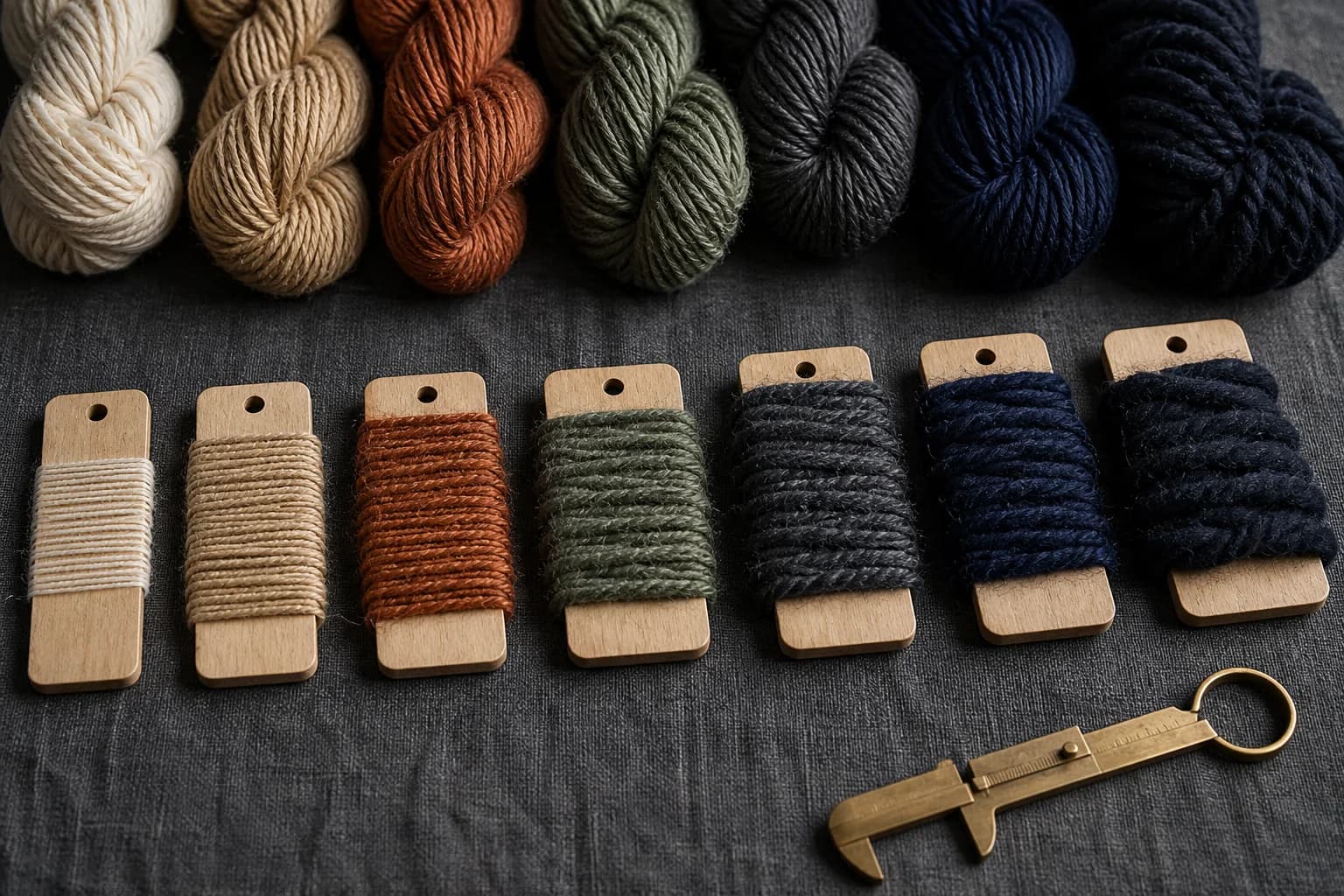
Wind the yarn side by side around an object with a consistent circumference. Keep the strands snug without stretching them, count the wraps across one inch, and repeat in several places.
Wraps per inch is subjective because the result changes with wrapping tension. Treat it as a way to select a likely category and first tool, not as proof of identity or suitability. A textured or uneven yarn makes the estimate less dependable.
Then make a swatch. Record the tool, stitch, unwashed gauge, washed gauge, fabric feel, and remaining yarn mass. If quantity is uncertain, choose a small project that can end gracefully rather than a fitted garment that depends on an exact supply.
Same category, new yarn
A shared category begins the substitution check
Starting in the requested weight family narrows the search, but it does not establish equivalence. Fiber, construction, care, total length, washed gauge, and the resulting fabric still need separate checks.
Follow the complete yarn-substitution workflow before buying the project quantity. It shows how to compare the pattern specification and candidate record, test the replacement, and reject a same-category yarn when the finished fabric does not work.
Common questions
Yarn-weight questions answered
Continue