Evidence on the band
How to read and record a yarn label
A yarn band carries several kinds of evidence: what the yarn is, how much is in the package, the maker’s suggested starting point, and how the material should be handled. Read each field separately, because no single symbol tells you whether the yarn fits a project.
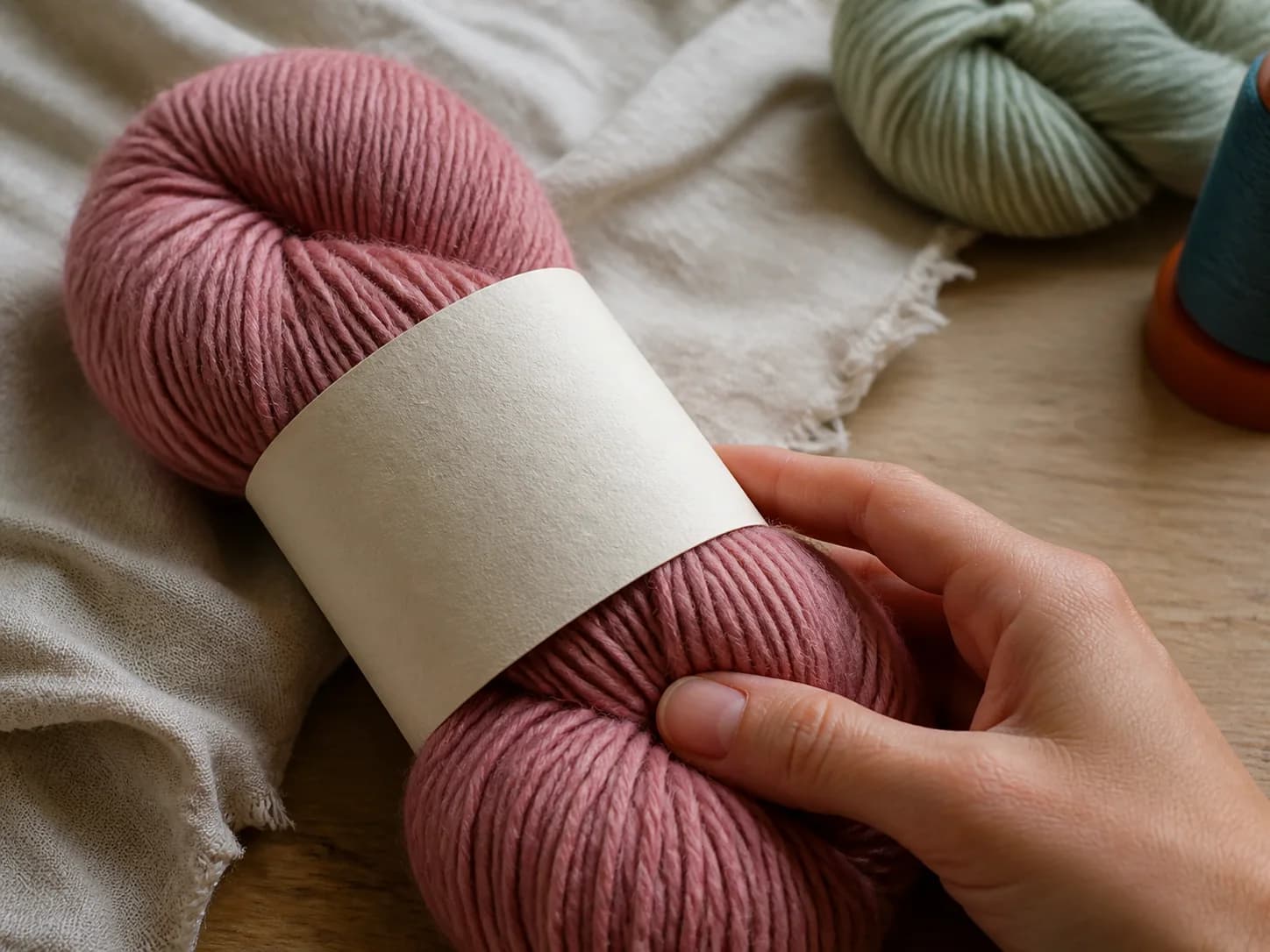
Before comparison
Build a complete label record
Do not copy only the yarn name and color. Product lines can change, names can be reused, and a later ball may carry a different quantity or care statement. A useful record preserves the whole package as it existed when you bought it. If the band wraps around the skein, open it carefully and photograph the outside, inside, barcode area, and every symbol panel.
| Record group | Copy from the label | Why it matters |
|---|---|---|
| Product identity | Maker or responsible business, yarn line, color name or number, and dye lot when one is shown | Finding the same product, matching color, and asking a precise question |
| Fiber statement | Every listed fiber and its percentage, including the full blend rather than the largest component alone | Comparing feel, care, recovery, wear, and recipient requirements |
| Package quantity | Net mass plus length, keeping the printed units exactly as written | Calculating project quantity and checking that balls with different put-ups are not treated as equal |
| Project guidance | Weight symbol, suggested needles or hook, and the stitch, count, and measurement used for gauge | Choosing a starting tool and planning the project-specific swatch |
| Care and origin | Written care instructions or symbols and the stated country of origin | Planning realistic care and retaining the label’s traceable information |
Add the purchase date and seller to your own notes. Those details are not yarn properties, but they help locate another ball or document a discrepancy. If the manufacturer publishes a product page, save its address without replacing the label photograph: webpages can be revised, while the band records the package in your hand.
Name the package
Distinguish yarn line, color, and dye lot
The maker or responsible business and the yarn-line name identify the product family. The color name or number identifies the intended shade. A dye-lot or batch number, when present, narrows that identity further to yarn colored together under the same dye-lot code. Copy the characters exactly; do not assume that a similar-looking code is a lot number unless the band labels it that way.
A repeated color number does not promise an invisible match between different lots. Buy enough of a lot for areas that must read as one continuous color. When matching is impossible, compare balls in the light in which the object will be used and decide deliberately where a transition can occur. Alternating rows or rounds may distribute a subtle difference, but it does not make two lots identical.
Also retain the barcode or stock code. It can help a seller locate the same package, but it should supplement—not replace—the readable yarn name, fiber statement, color, and lot. For an inherited or unlabelled yarn, record that the identity is unknown instead of assigning one from appearance alone.
What the strand contains
Read the full fiber statement and its scope
Copy every fiber name and percentage in the order shown. “Wool blend” is not an adequate project note when the band gives the actual proportions. A small component may be present for a practical reason, and the full blend is more useful when comparing care, durability, elasticity, drape, and skin contact. The percentages describe fiber content; they do not by themselves prove how the finished fabric will feel or behave.
Record the fibre content, country of origin, and responsible business printed on the label. Label requirements vary by product, material, and market, so copy the fields that are actually present.
An “RN” followed by digits is a U.S. Registered Identification Number, an optional way for an eligible business to identify itself instead of printing its full name. It is not a fiber grade, yarn size, color, or dye lot. If the band shows an unfamiliar business code, look for a printed label such as RN before deciding what it represents.
Use the fiber guide to turn the content statement into project questions. Then test the actual yarn rather than predicting a fabric from percentages alone.
Three separate values
Do not confuse net weight, length, and yarn weight
Read mass and length together. Two packages can both weigh 100 g yet contain different lengths, and one yarn line may be sold in more than one package size. When comparing value or calculating supply, write the pair as one statement—for example, “240 m per 100 g”—while still keeping the printed package values in your record.
The numbered thickness category is a filter, not an identity test. Weight, gauge, and tool ranges are guidelines; use the gauge stated in the pattern. Read the complete weight guide before treating two same-numbered yarns as candidates.
A starting sample
Interpret gauge and tool suggestions as a set
A gauge panel should be read as a relationship: a stated number of stitches and sometimes rows, measured across a stated distance, made in a stated stitch or sample style, with a stated needle or hook. A bare number such as “18” is incomplete unless you know whether it means stitches, rows, wraps, millimetres, or something else.
The maker’s needle or hook size is not a command and is not the same as your pattern’s tool size. It describes a reference starting point for that label sample. Your hands, stitch pattern, method, and desired fabric can require another size. If a pattern gives a gauge, use the pattern’s stitch and target; if it names only a suggested tool, make a swatch and judge the fabric before committing.
Keep metric and U.S. tool labels together when both are printed. Number and letter systems are regional and can be easier to misremember; the millimetre diameter is the clearest comparison for knitting needles and ordinary crochet hooks. Steel crochet hooks use a separate sizing convention, so do not infer a millimetre size from a familiar-looking number.
Follow the washed gauge-swatch method to turn label guidance into evidence about your project fabric.
Keep the treatment attached
Preserve written care instructions and symbols
Photograph the whole care panel, not only the wash symbol. Washing, bleaching, drying, ironing, and professional-care symbols answer different questions. A yarn may tolerate one part of a routine and prohibit another. If written instructions appear beside symbols, retain both rather than translating them from memory.
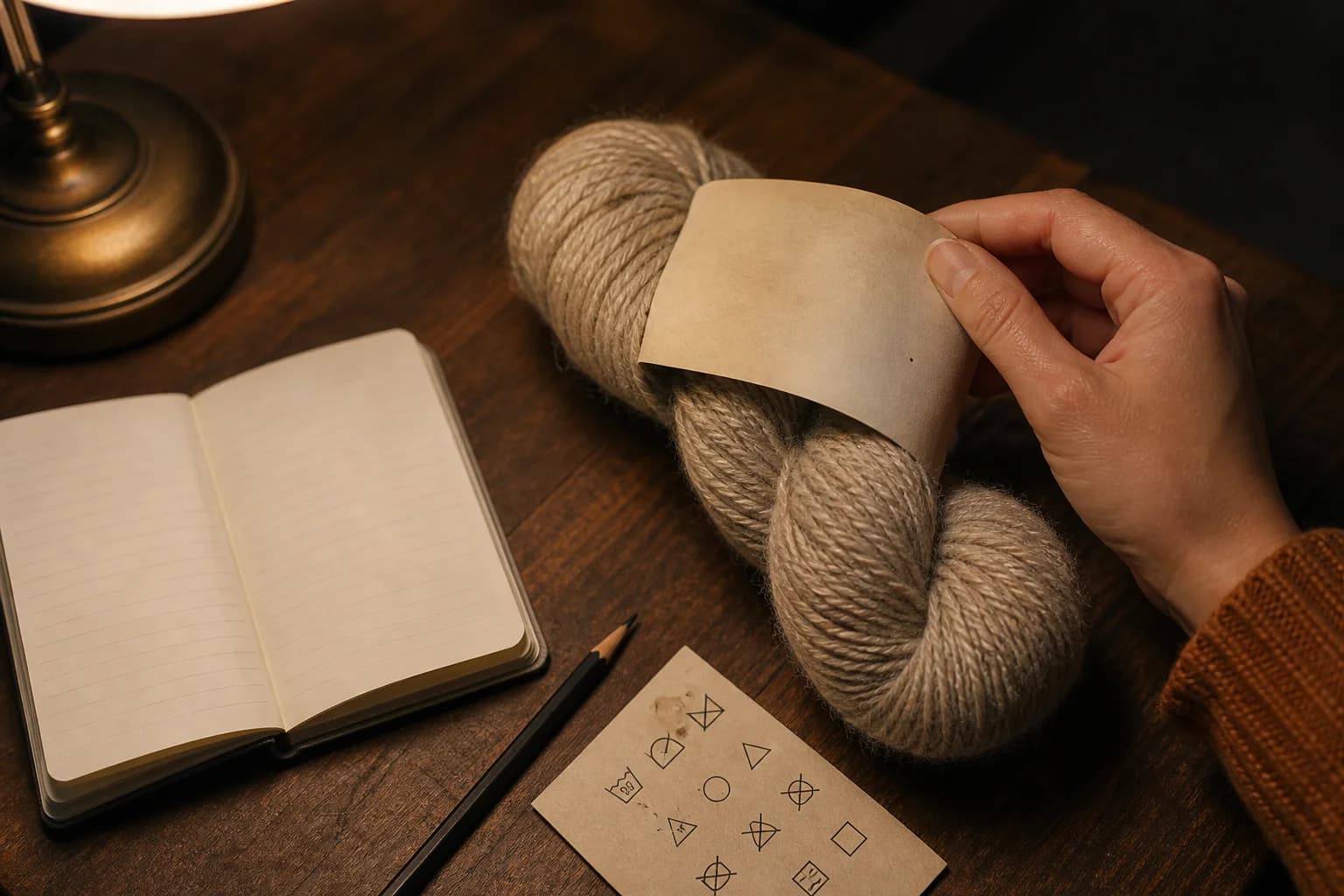
Apply the label instructions when washing a swatch, while also respecting any compatible directions in the pattern. If the finished object must survive a routine that the band does not support, resolve that conflict before buying the project quantity. Never promise a gift recipient an easier care method solely because one test swatch appeared unchanged.
When a symbol is unfamiliar, consult the legend used by the label’s market or ask the manufacturer. The directions attached to your yarn remain the evidence for that product.
Fictional practice label
Turn six printed fields into project evidence
Imagine a band containing the following invented values. They are an interpretation exercise, not a recommendation or a description of a real yarn.
The package mass is 100 g; category 1 is its broad thickness. Those are separate meanings of “weight.” The package supplies 400 m, which is the value used in a quantity calculation. The reference gauge says what the maker sampled with 2.75 mm needles, but a sock pattern’s own gauge and a washed project-stitch swatch decide suitability.
The fiber percentages support comparison with the recipient’s needs, but they do not prove softness, durability, or wash performance. The color and dye-lot fields are copied before buying more. Finally, the actual care panel is photographed; the summary “washable” would lose the temperature, cycle, drying, and other limits needed later.
Unknown means unknown
Handle missing, damaged, or conflicting evidence
- Check the inside of the band and any second tag before concluding a field is absent.
- Compare the product name, package size, color, and barcode with the manufacturer’s current page, but note if your physical band differs.
- Ask the manufacturer or seller a field-specific question and save the dated response with the project notes.
- Do not merge facts from two similar yarn lines or assume that a newer label silently applies to an older skein.
- If identity, care, or quantity remains uncertain, use the yarn only where that uncertainty has an acceptable consequence.
Appearance cannot verify fiber percentages, dye lot, treatment, or full remaining length. A burn test also creates fire and fume risks and cannot recreate the missing label record. For unknown yarn, state what you measured—a swatch, wraps-per-inch estimate, or remaining mass—separately from what you could not establish.
Use the record