Match the project, not the name
Yarn substitution calculator and guide
Convert the original yarn length into replacement packages, compare washed gauge, then check the fabric’s drape, recovery and care.
Compare two yarns
Enter each label and washed stitch gauge over the same span. Quantity is calculated for one colour. A matching category is a starting point, not approval of the fabric.
Example result for the measurements below.
5 replacement packages by length
- Required length including reserve
- 1,080 m / 1,181.1 yd
- Category comparison
- Same numbered category
- Original / replacement metres per gram
- 1.8 / 2.5 m/g
- Width using unchanged stitch count
- 90% of pattern width
- Length left after rounding
- 170 m
This replaces the stated yarn length; it does not predict consumption after changing gauge or fabric. Check row gauge, fibre percentages, drape, recovery and washing before buying the full quantity.
Step 1
Extract requirements before looking at replacements
Read the complete pattern, including notes, schematics, finishing, and every size table. A substitution made from the materials line alone can miss the actual gauge stitch, a second strand held together, a contrasting color, or a finishing allowance. Write facts from the pattern separately from your own preferences.
| Evidence group | What to extract |
|---|---|
| Target gauge | Stitches and rows, measurement span, stitch pattern, tool, and whether the sample is measured after washing or blocking |
| Original yarn | Maker, yarn line, weight category, fiber percentages, construction clues, package mass, and package length |
| Project quantity | Total metres or yards for the exact size, plus any per-color allocation and pattern-stated allowance |
| Finished result | Intended measurements, ease, drape, opacity, warmth, stitch definition, durability, and care |
| Construction constraints | Seams, steek, fringe, motifs, picked-up edges, colorwork, and any feature that changes yarn behavior or allocation |
Mark each requirement as fixed or flexible. A fitted garment’s finished circumference and care routine may be fixed, while its exact color could be flexible. In a decorative scarf, drape and visual texture may matter more than row gauge. Ranking the requirements makes a tradeoff visible instead of letting the easiest label match win.
If the pattern names only a discontinued yarn, find an older manufacturer product page, a physical label, or a reliable copy of the original specifications. Record where each fact came from and mark gaps as unknown. A retailer’s category filter or another maker’s description is a clue, not primary evidence about the original yarn.
Step 2
Use the candidate label as a screening record
Start by reading the complete candidate band. The yarn-label guide explains which fields to preserve. Compare them in a table or notes rather than holding several balls and relying on memory.
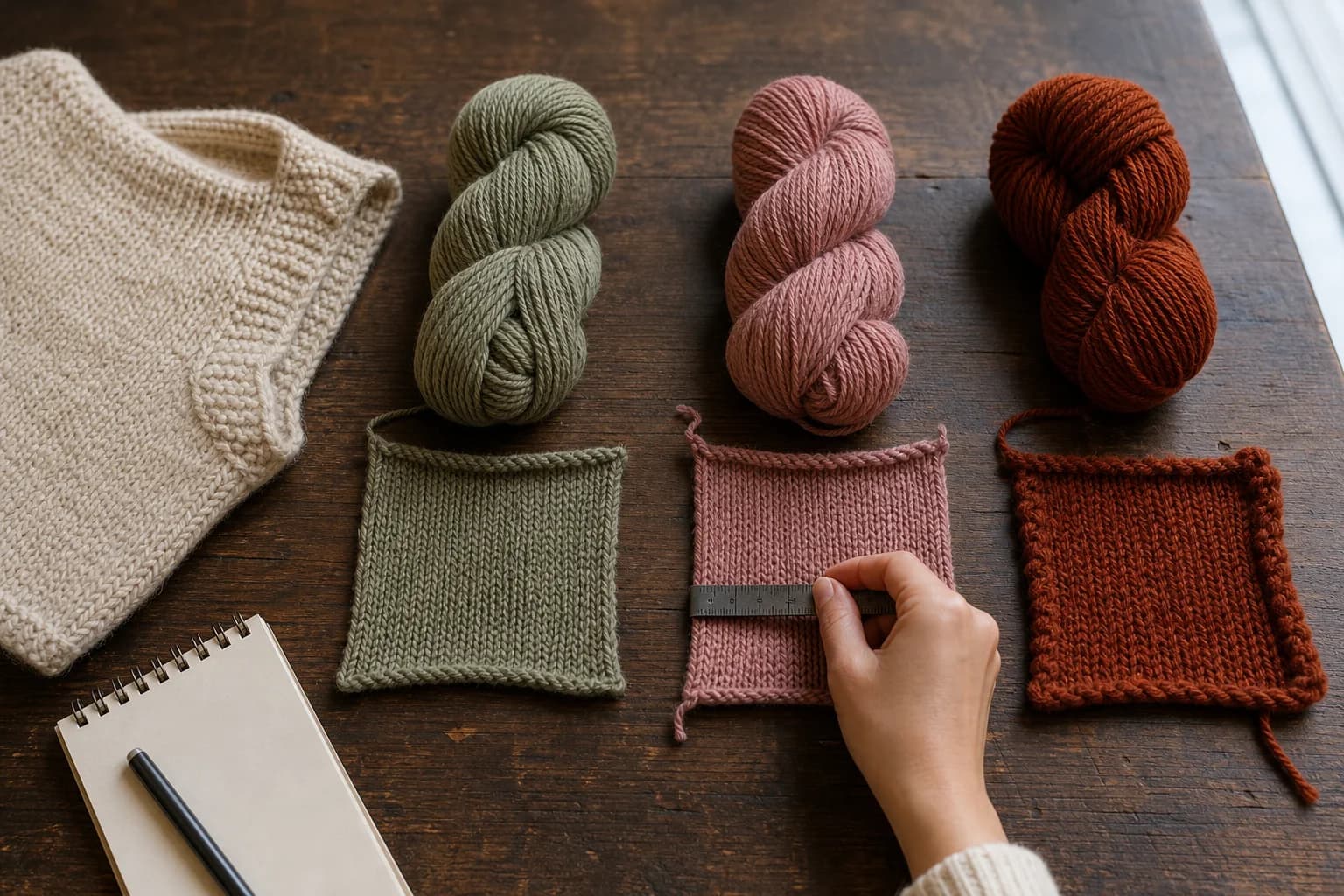
- Check the numbered weight category as a broad thickness screen. A nearby category may sometimes work, but it increases the amount of change you must prove in fabric and construction.
- Compare package length and mass as a pair. Convert both yarns to a common basis, such as metres per 100 g, only as a rough construction clue—not as proof that the strands or fabrics are equivalent.
- Compare every fiber percentage and the care instructions with the object’s requirements and recipient.
- Examine the strand: smooth or brushed, firm or lofty, single or plied, round or flat, even or deliberately irregular.
- Confirm that the needed total length is available in the desired color and, when shown, a suitable dye lot.
Do not require identical metres per 100 g. Two yarns can differ in fiber density, spinning, twist, trapped air, surface, and moisture. A close normalized length supports further testing; it does not overrule a poor swatch. A large difference is a reason to investigate construction and fabric more carefully, not an automatic mathematical verdict.
Weight categories give a broad starting point; the pattern gauge remains the target.
Step 3
Compare behavior, not just label similarity
The finished fabric is the point of substitution. List the qualities the original choice appears intended to provide, then ask whether the candidate can provide them at the required gauge. This is a functional comparison rather than a claim that one fiber always behaves in one way.
Consult the fiber guide for project questions, but keep the conclusion attached to the sample you actually tested. Similar fiber percentages can produce different fabrics when strand construction, finish, and gauge differ.
Step 4
Run a swatch designed for the substitution risk
Use the pattern stitch and construction method. Swatch in the round when the project gauge depends on circular work, and include the relevant colors when testing stranded colorwork. Make the sample large enough to measure away from edges and to handle like the eventual fabric. Label the candidate and tool immediately.
Record the unwashed stitch and row counts, dimensions, and fabric observations. Wash and dry according to the candidate label and any compatible pattern instructions. Then record the same evidence again. The full gauge-swatch guide gives the measuring and adjustment sequence.
Reaching stitch gauge is necessary for many sized patterns, but it is not enough. Check row gauge where shaping or vertical repeats depend on row counts. Hang or support the sample in a way that represents the project if the finished object will carry substantial weight. Rub a test area against the likely contact surface when abrasion or color transfer would be consequential.
If changing tool size fixes the count but produces an unacceptable fabric, the candidate has failed. Do not continue adjusting until the numbers pass while ignoring stiffness, openness, hand, or stability. A larger or smaller tool changes both dimensions and fabric structure.
Step 5
Convert total length, never the original ball count
Find the pattern’s total metres or yards for the exact size and divide by the length printed on one candidate package. Keep all values in the same unit and round up to a whole package.
If the pattern gives only original balls, multiply that count by the original length per ball first. Six original balls at 180 m each represent 1,080 m; they do not automatically become six balls of a candidate sold at 250 m each. Retain per-color requirements rather than pooling them into one total.
Use a pattern-stated allowance when one is provided. Otherwise decide whether swatching, alterations, motifs, fringe, joining method, or an uncertain estimate justifies a documented reserve. There is no single extra percentage that is correct for every project. The yarn-quantity guide covers these calculations and leftover estimates in detail.
Worked comparison
Follow one candidate from screen to decision
Consider this fictional example. A pattern requests a category 4 yarn sold as 100 g / 200 m, gives a washed gauge of 18 stitches and 26 rows over 10 cm in its texture pattern, and requires 900 m for the chosen size. The fabric should be resilient, show the texture, and tolerate the recipient’s stated care routine.
A candidate is category 4, 50 g / 105 m. On a 100 g basis it contains 210 m, reasonably close to the original’s 200 m. That supports making a swatch but proves neither thickness nor behavior. Its full fiber statement, construction, care panel, color, and available lot still have to pass the project brief.
Quantity comes from length: 900 ÷ 105 = 8.57, so the mathematical minimum is nine candidate balls. The original pattern’s ball count is irrelevant because the package sizes differ. If the maker has specified an additional length for the modification you plan, add that length before dividing rather than applying a vague reserve afterward.
Suppose the first washed swatch measures 19 stitches over 10 cm. The same pattern stitch count would produce a narrower object than intended. Make a fresh swatch with the next sensible tool, not a selectively stretched measurement. If the second sample reaches 18 stitches and 26 rows while retaining useful texture, recovery, and care performance, the candidate passes. If it reaches the count only as a loose, unstable fabric, reject it.
More than one variable
Handle special substitutions explicitly
Holding multiple strands together
Two strands held together create a new composite yarn, but category numbers do not add into a dependable result. Combined strand shape, fiber, tension, and color interaction all matter. Calculate quantity for every component separately and swatch the exact combination. Each component strand used throughout must cover the full project length even though the strands are worked together.
Colorwork and stripes
Match each color allocation, not only the grand total. Test contrast in the actual motif and check whether one yarn dominates in thickness, surface, or behavior. Different care responses between colors can distort the fabric, and color transfer can matter even when each yarn works well alone.
Unlabelled stash yarn
Estimate category and remaining supply only as measurements with uncertainty. Unknown fiber, treatment, and history make care and behavior harder to predict. Prefer projects that can stop at a natural endpoint, or combine the unknown yarn with a plan that does not depend on obtaining an exact replacement.
Pattern changes
Changing gauge and changing the pattern stitch count is a redesign, not a simple yarn substitution. It affects shaping, repeats, necklines, armholes, sleeves, borders, and yarn quantity. Make that calculation only when you understand every dependent instruction; otherwise select a yarn that can make the stated gauge and fabric.
Record the outcome
Use pass, test, fail, and unknown honestly
| Status | Meaning | Next action |
|---|---|---|
| Pass | The candidate meets a hard requirement using evidence already available | Keep it in the comparison |
| Test | The candidate could work, but only a project-specific sample can answer | Buy enough for a representative swatch before the full quantity |
| Fail | The candidate conflicts with a requirement that cannot move | Reject it even if its category or color is attractive |
| Unknown | A label field, pattern detail, or intended use has not been established | Find the missing evidence or explicitly accept the risk |
Reject a yarn when adequate quantity cannot be sourced, the care conflicts with the owner, the washed gauge and fabric cannot both be achieved, or a key wear, feel, color, or construction requirement fails. “Unknown” is not a pass. It is a request for more evidence or a risk that must be consciously acceptable for that project.
Save the rejected swatch and notes long enough to make the next choice. A failed candidate still tells you which normalized length, tool, gauge, construction, or fiber behavior moved in the wrong direction.
Before buying
Final substitution checklist
- The pattern facts and chosen size are written down.
- The candidate label is photographed and fully recorded.
- Hard requirements pass; unknowns are resolved or accepted.
- The washed stitch and row gauge are measured without stretching.
- The fabric’s use, feel, drape, recovery, and care are acceptable.
- Total length and each color allocation have been converted.
- Enough matching packages are available before the project begins.
Return to the yarn decision hub to compare this result with weight, fiber, label, gauge, and quantity references.